
Bathroom Cabinet Materials in 2026: A Complete Guide for Houston Homeowners
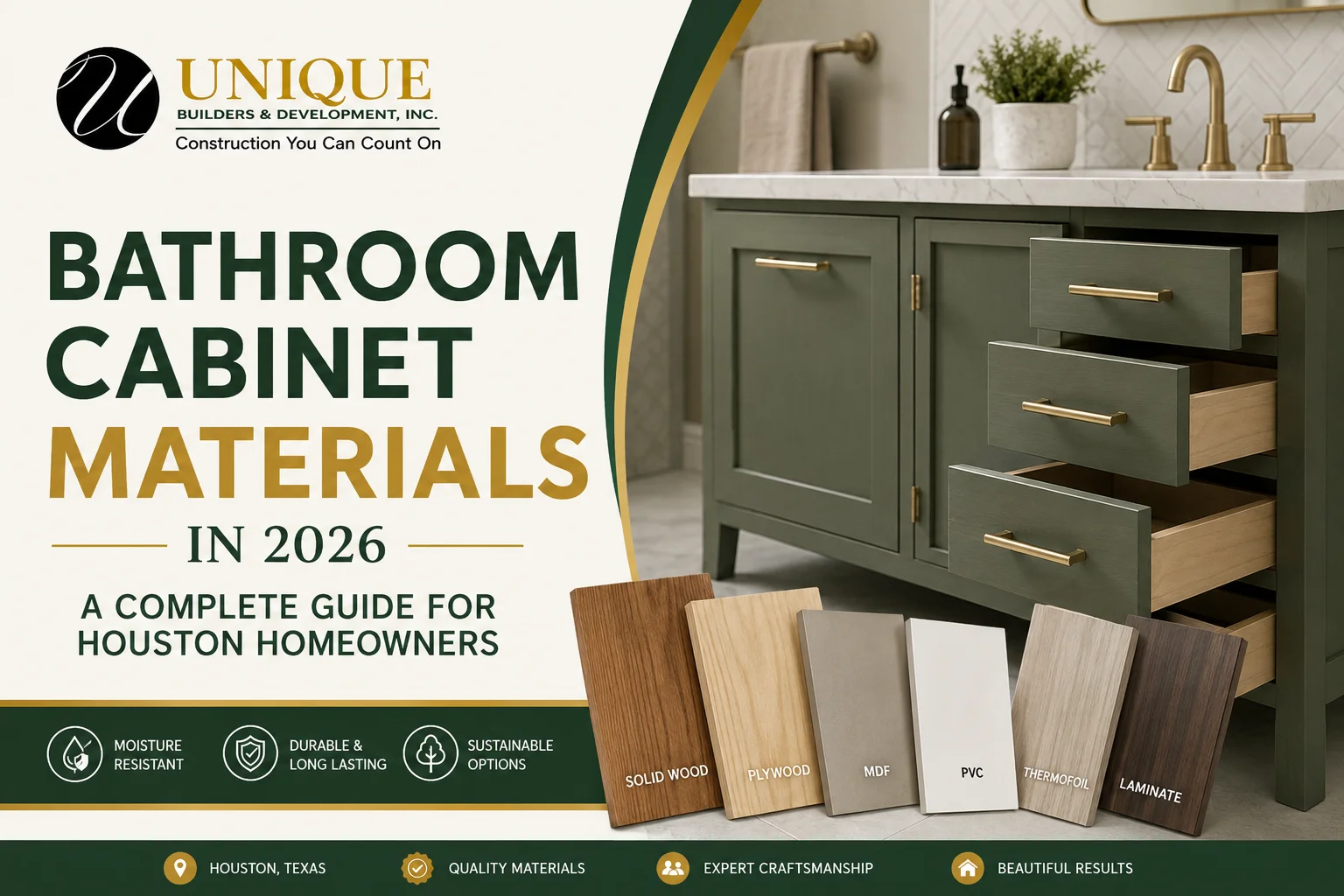
Bathroom cabinets do much more than provide storage. They influence the appearance, durability, maintenance, and overall functionality of your bathroom. In 2026, homeowners have more cabinet material choices than ever, from traditional solid wood and plywood to MDF, PVC, thermofoil, laminate, and newer sustainable materials.
For Houston homeowners, material selection is especially important because bathrooms experience frequent moisture, humidity, temperature changes, and daily use. The right cabinet material should therefore balance appearance, strength, moisture resistance, maintenance requirements, and budget.
If you are considering bathroom cabinet replacement in Houston, understanding the differences between these materials can help you make a better long-term decision.
Why Cabinet Material Matters in a Bathroom?
Bathroom cabinets are exposed to conditions that are different from cabinets in many other rooms. Steam from showers, splashes around sinks, cleaning products, and Houston’s humid climate can affect poorly selected materials.
A cabinet may look beautiful when newly installed but still fail prematurely if its construction and finish are not suitable for a humid environment.
Important factors to consider include:
- Moisture resistance
- Durability and structural strength
- Resistance to warping and swelling
- Ease of cleaning
- Finish and appearance
- Hardware compatibility
- Maintenance requirements
- Environmental considerations
- Overall project budget
Unique Builders and Remodeling Houston bathroom remodeling guidance also emphasizes moisture-resistant materials for Houston bathrooms because humidity can contribute to warping and long-term material damage.
-
Solid Wood Cabinets
Solid wood remains one of the most traditional and premium options for bathroom cabinetry in 2026.
Hardwoods such as maple, oak, cherry, and hickory can provide natural grain patterns and a timeless appearance. Solid wood can also be refinished, which may extend the useful life of the cabinets.
Advantages of Solid Wood
- Natural wood appearance
- Strong and durable construction
- Long service life when properly maintained
- Can often be sanded and refinished
- Wide variety of stains and finishes
Things to Consider
Solid wood is not automatically waterproof. Natural wood can expand and contract when exposed to changes in humidity. Proper construction, sealing, finishing, and installation are therefore important in a bathroom environment.
For homeowners who want a classic, high-end appearance and are prepared to invest in quality construction, solid wood can be an excellent choice.
-
Cabinet-Grade Plywood
Plywood is another popular choice for bathroom cabinets, particularly for cabinet boxes and structural components.
Cabinet-grade plywood is manufactured from layers of wood veneer bonded together. The cross-layer construction gives plywood good strength and dimensional stability.
Why Plywood Is Popular in Bathrooms?
Plywood offers several characteristics that make it useful for bathroom cabinetry:
- Strong construction
- Relatively lightweight
- Good dimensional stability
- Less prone to certain types of swelling than lower-grade particleboard
- Suitable for cabinet boxes, shelves, and structural components
Unique Builders’ custom cabinetry specifications include cabinet-grade plywood boxes and plywood adjustable shelving as part of their cabinet construction.
For many bathroom remodeling projects, plywood can provide a practical balance between durability and cost.
-
MDF Cabinets
Medium-density fiberboard, commonly called MDF, is manufactured from refined wood fibers combined with resins and compressed into panels.
MDF provides a very smooth and consistent surface, making it particularly useful for painted cabinet doors.
Advantages of MDF
- Smooth surface for paint
- Consistent appearance
- Minimal natural grain variation
- Good option for contemporary cabinet designs
- Often more affordable than premium solid wood
However, standard MDF should not be treated as waterproof. If exposed to significant water or moisture, conventional MDF can swell or deteriorate.
For bathroom applications, homeowners should ask specifically about moisture-resistant MDF products and the protective finish being used.
-
PVC Bathroom Cabinets
PVC is a synthetic material that has become increasingly popular for moisture-prone areas.
Because PVC does not behave like natural wood when exposed to moisture, it can be attractive for homeowners looking for a low-maintenance bathroom cabinet solution.
PVC cabinet boards are available in different constructions, including foam boards and hollow boards. Their characteristics can vary considerably, so homeowners should evaluate the quality and thickness of the specific product rather than choosing based solely on the word “PVC.”
Potential Benefits
- Moisture resistance
- Easy cleaning
- Low maintenance
- Lightweight construction
- Available in modern finishes
PVC can be particularly useful where moisture resistance is a major priority, although homeowners should also consider heat resistance, hardware quality, structural strength, and overall appearance.
-
Thermofoil Cabinets
Thermofoil cabinets are typically made by applying a vinyl-like surface over a manufactured wood substrate, creating a smooth and uniform finished appearance.
They are available in many colors and styles, including contemporary white and minimalist designs.
Benefits of Thermofoil
- Smooth, consistent finish
- Easy to clean
- Wide range of colors
- Can create a modern appearance
- Often budget-friendly
One important consideration is heat. Excessive heat can affect certain thermofoil surfaces, so proper installation and product selection are important.
Thermofoil can be a good choice for homeowners who prioritize a clean, contemporary look and easy maintenance.
-
Laminate Cabinets
Laminate is another versatile cabinet finish available in many patterns, colors, and textures.
Modern laminates can be designed to imitate the appearance of wood, stone, or other materials while providing a relatively easy-to-maintain surface.
Why Homeowners Choose Laminate?
- Many design options
- Easy maintenance
- Consistent appearance
- Good resistance to everyday wear
- Available at different price points
The quality of laminate and the substrate underneath it matter. A high-quality laminate surface does not necessarily mean the entire cabinet is high quality, so homeowners should evaluate the cabinet box, edges, joinery, hardware, and installation as well.
-
Particleboard: An Affordable Option
Particleboard is manufactured using compressed wood particles and adhesive.
It is often used in more budget-oriented cabinetry because it is economical and can be combined with laminate or other protective finishes.
However, moisture is an important consideration in bathrooms. Standard particleboard can swell when water penetrates the surface or edges.
That does not mean every particleboard cabinet is unsuitable for a bathroom. The quality of the product, edge protection, surface treatment, installation, and exposure to moisture all matter.
For a heavily used Houston bathroom, homeowners should carefully compare particleboard construction with moisture-resistant alternatives before making a decision.
-
Bamboo and Sustainable Cabinet Materials
Sustainability is an increasingly important consideration in 2026 bathroom design.
Bamboo is receiving attention because it is rapidly renewable and can provide a distinctive natural appearance. Sustainable wood products and recycled-content materials may also appeal to homeowners who want to reduce the environmental impact of a remodeling project.
Unique Builders’ 2026 bathroom remodeling trends guidance identifies sustainable wood and bamboo among materials gaining attention in modern bathroom design.
However, sustainability should be considered alongside durability, moisture resistance, manufacturing quality, finish, and expected lifespan.
Cabinet Material vs. Cabinet Finish: What Is the Difference?
One common mistake homeowners make is treating the cabinet material and cabinet finish as the same thing.
They are different.
For example, a cabinet may have:
Core material: Plywood
Door material: MDF or solid wood
Surface finish: Painted finish
Hardware: Soft-close hinges and drawer slides
Another cabinet could have:
Core material: Particleboard
Door: MDF
Surface: Laminate
Hardware: Standard hinges and slides
Therefore, when comparing cabinets, do not simply ask, “What finish is this?”
Ask what the cabinet box, doors, shelves, drawer components, and exterior surfaces are actually made from.
Which Cabinet Material Is Best for Houston Bathrooms?
There is no single material that is best for every bathroom.
The right choice depends on the bathroom’s moisture exposure, design, budget, expected lifespan, and maintenance requirements.
For Premium Durability
Solid wood and high-quality plywood construction are strong choices when premium construction and longevity are priorities.
For Painted Contemporary Cabinets
MDF can provide a smooth surface that works well with painted finishes, provided the product and finish are appropriate for the bathroom environment.
For Moisture-Focused Applications
PVC and appropriately engineered moisture-resistant materials can be worth considering when minimizing moisture-related concerns is a major priority.
For Budget-Conscious Remodeling
Laminate, thermofoil, and selected manufactured-wood products can offer attractive designs at different price points, provided the construction is appropriate for bathroom use.
What to Look for Beyond the Cabinet Material?
The material is only one part of a quality bathroom cabinet.
Pay attention to:
Cabinet Box Construction
Ask about the thickness and material used for the cabinet box. Plywood construction, for example, is commonly used for durable custom cabinetry.
Drawer Construction
Dovetail construction and solid drawer components can contribute to long-term durability.
Hinges and Drawer Slides
Soft-close hardware is increasingly popular in 2026 because it reduces slamming and provides a more refined user experience.
Edge Protection
Edges and joints deserve special attention in bathrooms because they can be vulnerable to moisture penetration.
Finish Quality
A high-quality finish should provide an attractive appearance while helping protect the underlying material.
Installation
Even high-quality cabinets can experience problems if they are poorly installed. Proper leveling, securing, sealing, plumbing coordination, and moisture management all matter.
Bathroom Cabinet Trends in 2026
Bathroom cabinetry in 2026 is moving toward a combination of clean design, practical storage, natural materials, and personalized functionality.
Some notable trends include:
Floating Vanities
Floating vanities create an open visual space underneath the cabinet and can make smaller bathrooms feel less crowded. They also provide a contemporary appearance.
Natural Wood Finishes
Natural-looking wood finishes add warmth to minimalist bathrooms and can complement stone, tile, and metal accents.
Mixed Materials
Combining wood-look surfaces with stone countertops, metal hardware, glass, or textured tile can create more visual depth.
Minimalist Cabinet Designs
Flat-panel and simple Shaker-style doors remain useful for homeowners who want a clean design that can remain attractive beyond a single trend cycle.
Better Internal Storage
Modern bathroom cabinets increasingly focus on how storage works inside the cabinet, not just how the exterior looks. Pull-outs, drawer organizers, adjustable shelves, and dedicated storage for toiletries can make a bathroom much easier to use.
How to Choose the Right Bathroom Cabinet Material?
Before ordering new cabinets, consider these questions:
- How humid is the bathroom?
- Is the vanity located close to a shower or bathtub?
- How frequently will the bathroom be used?
- Do you prefer natural wood or a painted finish?
- How much maintenance are you comfortable with?
- How long do you expect the cabinets to last?
- What is your remodeling budget?
- Do you need custom dimensions?
- Which countertop material will be installed?
- Will the cabinet design match the rest of the bathroom?
Taking the time to answer these questions can prevent expensive mistakes and help you select cabinetry that works with the entire bathroom design.
Should You Replace or Refinish Your Bathroom Cabinets?
Replacement is not always necessary.
If your existing cabinet boxes are structurally sound and the layout still works, refinishing or replacing only certain components may be worth considering.
However, replacement can make more sense when cabinets have:
- Significant water damage
- Swollen or deteriorated panels
- Broken cabinet boxes
- Outdated layouts
- Poor storage
- Damaged hardware
- Persistent moisture-related problems
- A design that no longer suits the bathroom
A professional evaluation can help determine whether replacement, refacing, or refinishing is the better approach.
Final Thoughts
Bathroom cabinet materials have evolved significantly, giving Houston homeowners more choices in 2026. Solid wood, plywood, MDF, PVC, thermofoil, laminate, particleboard, bamboo, and other engineered materials can each serve a purpose when properly selected and installed.
The most important consideration is not simply choosing the most expensive material. Instead, choose a cabinet system that matches your bathroom’s moisture conditions, design goals, storage requirements, maintenance expectations, and budget.
For Houston bathrooms, moisture resistance and construction quality deserve particular attention. A well-designed cabinet with appropriate materials, quality hardware, a durable finish, and professional installation can provide attractive storage and dependable everyday performance for years.
If you are planning a bathroom cabinets replacement in Houston, Unique Builders and Remodeling Houston can help you evaluate cabinet materials, finishes, storage options, countertops, sinks, faucets, and the overall bathroom design. The company’s Houston bathroom cabinet replacement service includes custom cabinet options and project coordination from design through installation.
Get a FREE Expert Evaluation Today!


FAQ’s
What is the best material for bathroom cabinets in 2026?
There is no universal best material. Plywood, solid wood, MDF, PVC, laminate, and other materials can work well when selected according to the bathroom’s moisture exposure, design, budget, and intended use.
Is plywood good for bathroom cabinets?
Yes. Quality cabinet-grade plywood is a popular choice because of its strength and dimensional stability. Proper finishing and installation are still important in a humid bathroom.
Are MDF cabinets suitable for bathrooms?
MDF can work well for bathroom cabinet doors and painted finishes, but standard MDF should be protected from prolonged water exposure. Moisture-resistant products may be more appropriate for certain applications.
Are PVC bathroom cabinets waterproof?
PVC is highly moisture-resistant, but homeowners should evaluate the complete cabinet construction, joints, hardware, and installation rather than assuming every PVC cabinet is completely waterproof.
Are solid wood cabinets good for Houston bathrooms?
Solid wood can be an excellent premium option, but it should be properly sealed and finished because natural wood can respond to changes in humidity.
What should I prioritize when replacing bathroom cabinets?
Prioritize moisture suitability, cabinet construction, hardware quality, storage functionality, finish durability, proper installation, and overall compatibility with your bathroom design.
Can I customize the material and design of my bathroom cabinets?
Yes. Custom cabinetry can allow homeowners to select dimensions, materials, colors, finishes, hardware, storage configurations, and design details to suit the bathroom.
Why is moisture resistance important for Houston bathroom cabinets?
Houston’s humid climate makes moisture management especially important. Selecting suitable materials and protecting vulnerable edges and joints can help reduce the risk of swelling, warping, and premature deterioration.


